This was my third AI hackathon.
This time, I joined the
AI Film Hackathon.
It was a hackathon where you make a film using AI.
It was organized by AIMovieStudio / Tokyo AI (TAI).
One of the rules was that we had to create our work using the sponsor’s tool, Magnific.
The atmosphere was completely different from my first and second hackathons.
And this time, I was on a team of four.
To tell you how it ended first:
we finished our film at the very last minute (haha).
It wasn’t a case of using amazing technical skills to make an incredible piece of work.
If anything, we spent a lot of the time just talking.
But this time, that was a lot of fun.
At the venue, there was a LOVOT robot called Uisshii wandering around on its little body.
It came over to me, blinking its eyes, and didn’t want to leave. It looked like a stuffed toy and was so cute that I ended up playing with it quite a bit before things started.
A participant nearby told me in English, “This one is pretty expensive to buy.”
When I asked, “But it doesn’t talk, right?”, they explained that it isn’t the kind of robot that has conversations — it takes photos with the camera on top of its head.
Most of the participants were meeting for the first time, but whenever Uisshii went over to someone, people naturally smiled. I heard someone say something like “It’s so fluffy,” and I feel like just having that little robot there made the room a bit more relaxed.
Toward the end, it was being held by someone who seemed to be on the staff.
A team of four this time
This time, our team had four people, including me.
Counting what I found out later, it was a pretty international team.
The event was run mostly in English, and our conversations within the team were mostly in English too. Every now and then, there was some Japanese interpretation.
But when we formed the team, I knew almost nothing about the other members.
Where they lived.
Where they were from.
What they usually did.
Without really knowing any of that, we started with something like:
“Okay, let’s make something together.”
That’s one of the things I find interesting about hackathons.
In everyday life, you rarely get to suddenly spend several hours making something with people you know nothing about.
I didn’t even bring paper or a pen
And on this day, I had
brought no paper and no pen at all (haha).
When someone suggested that we brainstorm with paper and pen, I was actually a little surprised. Since it was an AI hackathon, I had imagined we might share ideas digitally, in something like Google Docs. “Oh, it’s more analog than I expected,” I thought. That’s why I hadn’t brought either.
When I said I didn’t have any paper or a pen, the teammate sitting next to me tore a page out of his notebook and gave it to me. I thought that was kind, and also a little funny.
At that point, I didn’t even know he was from France.
So now I had paper.
But
no pen.
I started walking around the venue looking for one.
When I checked the reception area near the entrance, there were pens I could borrow.
Lucky!
But
there were only red ones.
So all of my brainstorming notes that day were in red (haha).
Of course, we used digital tools later on. But our brainstorming started in this unexpectedly analog way.
I wrote words,
drew arrows,
drew circles,
and kept getting whatever came to mind down on paper.
At some point, I casually drew a character that looked kind of like a Martian.
My teammate next to me really liked this Martian.
I have no idea what about it he liked so much (haha).
But he kept looking at the drawing again and again, and he seemed to really like it.
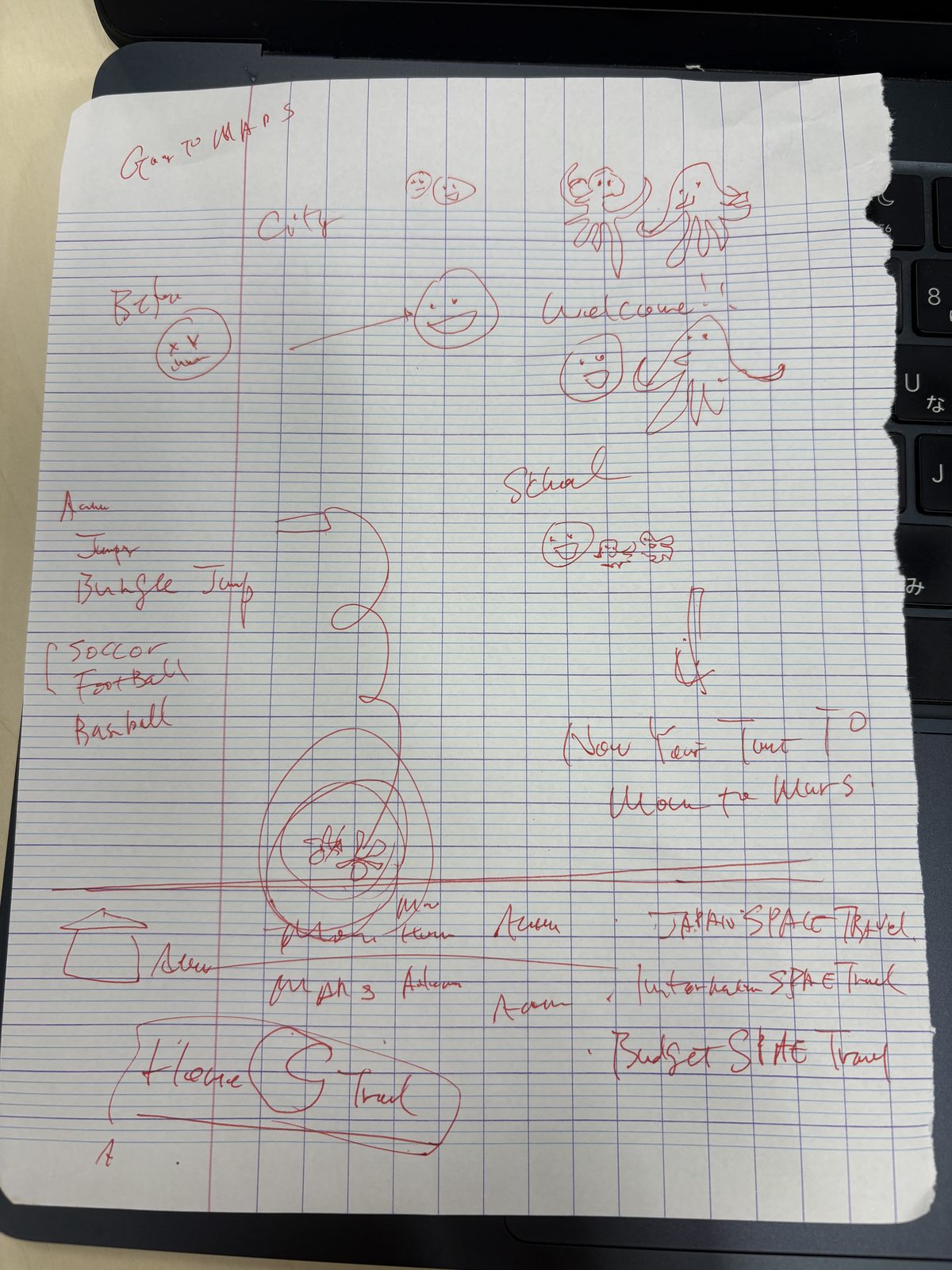
When I look at this page now,
it brings back a lot of that day.
It’s not a neat project plan, and it’s not a finished piece of work.
It’s just whatever I came up with in the moment, scribbled down in red pen.
But sometimes a page like this holds onto the feeling of the day better.
We spent a long time brainstorming
Our team spent a lot of time talking, starting from
“What should we make?”
We came up with ideas, asking things like:
What about this?
What about that one?
Actually, wouldn’t it be better to do it this way?
And as we kept talking, the time kept slipping away.
Looking back,
we spent way too much time brainstorming.
Hackathons have a time limit.
Ideally, you should decide at some point and start building early.
But our team just kept talking.
And then, partway through, it was:
“Wait, it’s already this late?” (haha)
Then we built it all in a rush
Once we decided on the idea, we really had to hurry.
Making the video,
preparing the materials we needed,
putting everything together,
and getting it ready to submit.
From here, things suddenly got tense.
On the day, we also used Slack to communicate as a team while we worked.
At first, all four of us were working on our own laptops.
But gradually, there was no time for that anymore.
The teammate next to me had been taking the lead quite a bit, but partway through,
he needed help.
So he started asking another teammate — who turned out to be able to work with video — to come over and operate things on his laptop.
In the end, it felt like that person’s skills were what made it all come together.
Magnific, which we used this time, was a tool I was using for the first time.
Honestly, I couldn’t use it well right from the start.
I was able to make parts of the video only because that teammate kindly showed me how.
Even with the deadline getting closer and everything moving so fast, that teammate stayed patient and showed me step by step. I really appreciated that.
After that,
all we had to do was put the parts together and we’d be done.
…except
we were already past the deadline (haha).
But luckily,
the submission deadline was extended by 15 minutes.
We somehow finished it in those 15 minutes,
and finally submitted it.
It was really, really close.
In its own way, I think that was a very hackathon-like experience.
Normally, when I’m making something on my own, I find myself thinking:
I want to fix this a little more.
This part bothers me.
I want to change just one more thing.
But at a hackathon,
when time’s up, it’s over.
Even if it isn’t 100% complete, you get it into shape and submit it.
I find that forced deadline interesting too.
Not everyone was a super-technical expert
I don’t think our team was especially advanced technically.
I’m not an engineer myself.
And the other members didn’t feel like super engineers who could build anything in an instant either.
One person on the team was using paid versions of ChatGPT and Claude Code.
At first, I thought:
“This person must be way, way ahead of me.”
But once we actually worked together, it didn’t feel like he was in a completely different world.
Of course, there were plenty of things he knew more about than I did.
But it wasn’t like
he understood everything,
or could do anything in an instant.
He thought things through normally,
tried things,
asked AI,
and if it didn’t work, thought about it again.
That’s how he was building.
Watching that, I thought:
“Oh, everyone is building things while using AI.”
Near the end, I found out my teammate was traveling
The event was getting close to the end.
We had submitted our work, and I think there were about 30 minutes left before the event finished.
Then the teammate next to me started handing out snacks — souvenirs from Osaka.
Why souvenirs from Osaka?
I wondered, so I asked.
The answer was:
“I went to Osaka a few days ago.”
Oh, so he took a trip to Osaka.
That’s what I thought at first.
But as we kept talking, it seemed like
he was traveling in Tokyo, too.
Wait, why??
That’s when I finally heard the whole story.
He had
come from France.
And he didn’t live in Japan.
He was in the middle of a two-to-three-week trip around Asia.
What?
You’re traveling?
I thought (haha).
Until then, I had completely assumed:
“He must be an international participant who lives in Tokyo.”
When I saw someone from overseas at an AI hackathon in Tokyo, I had just assumed that.
But that wasn’t the case.
He had come to Tokyo while traveling,
and somewhere in his travel plans,
joining an AI hackathon
was part of the itinerary.
That was really refreshing to me.
After that, the other teammates started introducing themselves too.
The other two lived in Tokyo.
Only then did I finally realize:
“Oh, so that’s who the four of us were.”
Joining a hackathon while traveling
When you think about it, it’s totally possible.
Look for local events on Luma, Meetup, and similar platforms,
and if the dates work out, join.
When I thought of traveling abroad, I mostly pictured
sightseeing,
eating good food,
and visiting famous places.
But
joining a hackathon wherever you’re traveling
is another way to spend your time.
It was an idea I had never had before.
And he wasn’t just showing up to watch.
He formed a team with people he didn’t know and made a piece of work together with us, just like everyone else.
I thought, “So this is another way to take part.”
Meanwhile, the people who came to win were seriously impressive
Of course, there were also highly skilled participants at the venue.
The ones that stood out to me most were
people who joined alone and built something really polished by themselves.
There we were, a team of four, going:
What should we do?
Is this okay?
We’re out of time!
all in a rush (haha).
And right next to us, there were people quietly building on their own.
And they properly finished and presented their work.
The people who placed near the top were also participants who were taking it very seriously.
They really were impressive.
At the same event, there were
people who were really focused on winning,
people who wanted to try new technology,
people who came to meet others,
and teams like ours that were having fun building while talking.
This range of people is another thing I find interesting about hackathons.
This time, I didn’t really “master a skill”
Honestly, I don’t really feel like
I completely mastered some new technology this time.
As for the tools we used,
I didn’t understand all of them.
And if you asked whether I’ll be using them every day from now on, there are probably some I won’t.
But I had lots of small discoveries, like:
So this is possible.
So this is a way to make things.
So these are the kinds of people who join.
And most of all,
talking with people I didn’t know while making one thing together was fun in itself.
This time, that was enough.
I think it’s fine to go “half for fun”
This time, I didn’t join thinking
I’m definitely going to win,
or I’m definitely going to get a prize.
Of course, once I joined, I wanted to finish our work.
I wanted to see it through to the end.
But just as much as that,
I was enjoying being there.
Talking with people I didn’t know,
drawing a mysterious Martian in red pen,
running out of time,
everyone scrambling at the end,
and somehow finishing it.
I think that’s fine.
You don’t have to win a prize at every hackathon.
You don’t have to pick up amazing technical skills every time.
Going half for fun.
I think that’s a perfectly good way to take part too.
Three hackathons, all completely different
This was my third AI hackathon.
But
all three were completely different.
For my first one, I didn’t even know the word “hackathon” until a few days before.
My second one was run entirely in English, with almost everyone there from overseas.
And for my third, I made an AI film with an international team of four.
Even though they were all AI hackathons,
the participants,
the atmosphere,
how teams formed,
what we made,
and the skills needed
were all quite different.
So after just one hackathon, I don’t think I could say
“This is what hackathons are like.”
The next one might be completely different again.
And right now, that’s part of what makes it fun.
Looking back, our brainstorming took a long time, and we ended up rushing to finish at the very end. But I genuinely had a great time. I learned things I hadn’t expected to learn, and I’m grateful for how kind and helpful my teammates were throughout the day.
Somehow, that slightly chaotic day became a very special one for me.
One of my teammates has probably already gone back to France, and the other two live in Tokyo. I don’t know when or where, but I’d be happy to run into any of them again at another hackathon someday.